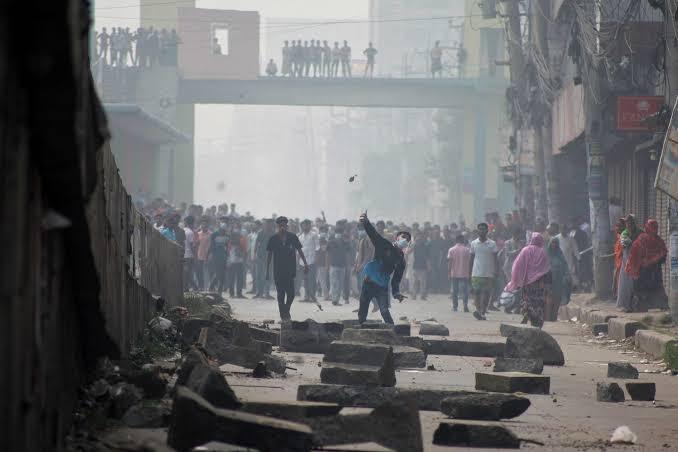
Bangladeshi police fired tear gas and stun grenades on Tuesday as thousands of garment workers took to the streets in a fresh Bangladesh wage protest. The unrest followed the postponement of a key wage board meeting, and demonstrators blocked the main Dhaka Mymensingh highway. Protesters threw bricks and set vehicles on fire, turning a demand for a minimum wage hike into a violent standoff.
Background of the Bangladesh Wage Protest
Bangladesh is home to about 170 million people and is the world’s second largest garment exporter after China. Its factories produce clothes for well known international brands, and the sector brings in roughly $38 billion a year while employing more than four million people. Readymade garment exports remain the backbone of the country’s economy, which is why any disruption draws immediate attention.
Labour unrest began in October, when workers said their pay no longer covered basic living costs. Food, housing, transport and healthcare have all become more expensive, and many families say they are cutting spending on essentials. In early November, the government announced a wage board to review pay in the sector, but protests continued in several industrial areas.
The wage board includes representatives of both employers and workers. It was formed earlier this month to negotiate a pay rise, and its chairman has said the first salaries under the new scale would be paid in January. Workers, however, fear that their demands will not be reflected in the final proposal.
Details of the Clashes in Gazipur and Beyond
On Tuesday, workers in the Gazipur garment hub shouted slogans and blocked roads, demanding a monthly minimum wage of 30,000 taka, about $240. That figure is a 140 percent increase over the current minimum of 12,500 taka. Police responded with tear gas and stun grenades, and some workers were seen throwing the canisters back toward officers.
Tension was also high in the other garment centres of Savar and Ashulia on the outskirts of Dhaka. Most factories had opened as normal in the morning, but production stopped once protests spread to the highway. Around 500 of the country’s 4,500 garment factories are now shut, according to sources, which has added to the anger among workers.
Many workers are worried about the no work no pay rule. Under the labour law, owners can suspend operations and withhold wages when production is disrupted. Workers say factory closures are therefore hurting their already thin incomes, even as they continue to press for better pay.
The wage board meeting that was due on Monday was postponed after a member representing workers said he was unwell, according to a source at the owners’ association. The board has now fixed its next meeting for November 23. Until then, the situation on the ground remains uncertain.
What Workers and Authorities Are Saying
Workers say they are frustrated by what they see as slow progress. A 24 year old protester named Khanom said owners appear unwilling to meet salary demands and are dragging their feet. Another worker, Rakib, 28, said, “We want to return to our machines,” and added that he is unsure whether wage board members understand what workers need.
The two main employer bodies, BGMEA and BKMEA, issued a joint statement urging that wage negotiations resume as soon as possible. Their message reflects growing concern in the industry that prolonged garment factory shutdowns could damage orders and relationships with global buyers.
Border Guard Bangladesh increased patrols across the industrial zone and deployed hundreds of personnel. The force said its headquarters was watching the situation from a monitoring cell, and that it was using drones and body cameras to keep track of demonstrations. Officials have not announced any change to the wage timeline, which still points to a decision in December and implementation in January.
Impact on Industry, Exports and the Region
The timing is difficult for the industry. The weeks before Christmas are the busiest export period for Bangladeshi clothing makers, and delays can push buyers to look at other suppliers. The United States is the country’s largest single market, while the European Union is its largest trading bloc, so any lasting interruption could be felt in both.
For workers, the stakes are personal. A prolonged Bangladesh wage protest means lost days of income for families who have little savings, especially if more factories close. For owners, the choice lies between higher labour costs and the risk of losing orders, a balance that wage negotiations have struggled to settle for years.
The effects reach beyond Bangladesh. Global retailers depend on stable supply chains, and instability in a major hub can raise costs elsewhere. Readers following wider regional and economic developments can find more in the international news section and the world coverage at Pakistan Chronicle. Market sentiment is also shaped by global events, as seen in the report on tech stocks recovering after a global sell off, and by tensions covered in US strikes on Iran raising fears of renewed war.
Conclusion: What Happens Next
All eyes are now on the wage board meeting scheduled for November 23. If talks make visible progress, protests could ease and factories may return to normal output before the holiday rush. If they stall again, the Bangladesh wage protest could widen and deepen the strain on one of South Asia’s most important industries.
A lasting solution will likely need a compromise that raises pay enough to match living costs while keeping factories competitive. Until a final figure is announced in December, workers, owners and the government will remain under pressure to find common ground without further violence.
FAQs About the Bangladesh Wage Protest
Why are Bangladeshi garment workers protesting?
Workers are demanding a higher minimum wage because rising prices for food, housing, transport and healthcare have made their current pay insufficient. They are asking for 30,000 taka a month, compared with the present 12,500 taka. Protests began in October and grew sharper after a wage board meeting was postponed, which many workers saw as another delay in addressing their concerns.
What happened during the clashes on Tuesday?
Police used tear gas and stun grenades against thousands of workers who blocked roads and the main highway between Dhaka and Mymensingh. Protesters threw bricks and burned vehicles, and tension was also reported in Savar and Ashulia. Border Guard Bangladesh increased patrols and began using drones and body cameras to monitor demonstrations across the industrial belt.
How many factories are affected by the shutdowns?
According to sources, around 500 of the country’s 4,500 garment factories are currently closed. The closures add to workers’ anxiety because the no work no pay rule allows owners to withhold wages when production stops. Employer groups have asked for negotiations to restart quickly so that normal operations can resume and further losses can be avoided.
When will the new minimum wage be announced?
The wage board, which includes employer and worker representatives, plans to announce the new minimum wage in December. The revised pay is expected to take effect in January. The board’s next meeting is scheduled for November 23, and the outcome of that session will show whether talks are moving toward a deal or facing more delays.
Why does this matter for global buyers and the economy?
Bangladesh is the second largest garment exporter in the world and supplies major international brands, with the United States and the European Union as its biggest markets. Disruption during the busy pre Christmas period can delay shipments and raise costs for retailers. It also affects millions of livelihoods and the country’s export earnings, making the wage dispute important well beyond the factory floor.